Skip to content
Formerly, HistoryMiami Museum

My father was a fisherman, as were his fathers, and since I followed in their footsteps, I am a fisherman, too.

He fished the streams of Scotland as a boy and, when he came over to Orlando, he fished the freshwater lakes and Indian River, catching bass, trout and flounder. Later, one of his outstanding Metropolitan Tournament winning catches was a 25-pound redfish he caught while fishing with his brother-in-law, Carl Lauer, at Flamingo in 1962.

In 1963, my father retired from Southern Bell and went to Freeport, Grand Bahama, to manage the telephone company for a few years. Then he consulted for a few independent telephone companies around Florida until he died in 1970 at 67 years old.

My family and I first moved to South Florida in 1945. As a kid, I remember winning some fishing contests, then identifying fish on an outdoor radio show in Jacksonville. I fished the Palm Beach Inlet Dock with my father and, in the evening, jacks and snook would chase schools of mullet onto the beach and the rocks. A large moray eel lived in a pipe by the dock, and there was only one building to be seen across the water on Riviera Beach (a nightclub?).

I came back in the 1960s to fish the mullet run each fall, becoming the only Miami member of the Jetty Conchs fishing club.

In 1946, we moved to Coconut Grove and kept our boat in a canal near the end of Southwest 22nd Avenue. This area east of Bayshore Drive was all mangroves at that time. I remember fishing off Key Biscayne before they built the bridge, and in the bay, we caught snapper, trout and mackerel using small surf rods with 36-pound squidding line. Boats would come into Dinner Key, and then people would load their car trunks full of fish.

After we moved back to Jacksonville in 1948, we often fished the bridges around St. Augustine, Matanzas Inlet and the old Mandarin loading-dock piling south of Julington Creek on the St. Johns River.

In 1954, my parents moved back to the same neighborhood in Coconut Grove and bought the house where my family and I live now. At this time, my father and I became interested in spin fishing. Our first reels were Garcia Mitchells, then Orvis 100s.

In 1955, I started working summers at The Tackle Box fishing store at Southwest 27th Avenue and U.S.?1, where I built custom fishing rods and repaired reels for the proprietor, Jack Primack. While working there, I met many people who were influential in my early development as a light-tackle sport fisherman. Some of the names I remember are: Eddie Miller, Joe Brooks, Lee Cuddy, Arthur Beryl, Buddy Hawkins, Capt. Bill Smith, Capt. Stu Apt, Capt. Gary Simmons, Capt. Bill Curtis, Chico Fernandez, Flip Pallot and John Emery.

In 1958, I went away to the Army and upon my return in 1961, I started surveying for the new Dade County Port of Miami. I also built custom bonefishing skiffs at the Glenncraft boat company. Eventually, I built my own skiff and went fishing most of the time. During this period, I developed innovations to the technology of sport fishing, some of which are still being used in the fishing community today.

Among the innovations I primarily created are: Inside/Outside Fly, Mutton/Cockroach Fly, Puff Permit Fly, Twenty-Times-Around Knot, wire-leader connection, Duncan Loop Knot, deep jig glow worms, boat side curtains and rod blank designs. Other innovations that I contributed to were: arrowhead jigs, inverted flies, loop-on fly tippits, Redfish Fly, sinking head fly lines, blue fly lines, red bandannas and the first fiberglass push pole.

I returned to college part-time, eventually obtaining an engineering degree from the University of Miami and several professional licenses. I have recently retired with 30 years of experience as a construction management engineer. I also became involved in several conservation issues, such as the creation of Biscayne National Park and the banning of commercial fishing in Everglades National Park.

Many things have changed now, but partially because Biscayne National Park was created at our doorstep, we still have fish in Biscayne Bay. On a recent trip, I caught a nice mutton snapper in park waters. I used the head and bones to make fish soup and the sauce for my quenelles.

I still look forward to fishing, although it is now a new era and there are fewer fish than there were back in the ‘50s and ‘60s. However, we can turn the tide if sport fishermen keep pushing for reforms in the preservation and conservation of our natural resources.

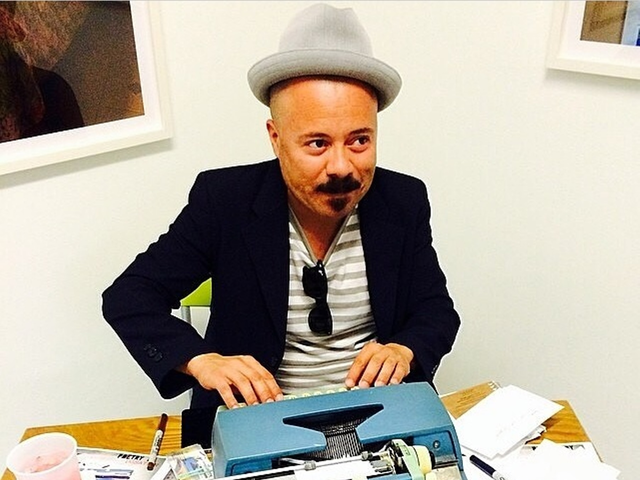
It was the summer of 2003; I was living in a very old and ugly apartment building between Biscayne Boulevard and Northeast 2nd Avenue, off of 33rd Street.

I had a bitter, mentally unstable landlord that walked around with a concealed weapon. I had a part-time gig at the Historical Museum of Southern Florida, now HistoryMiami. I would give guided tours of the permanent galleries and write historical theater scripts for their summer camp program.

Every afternoon of that summer I would arrive home from work, and I remember noticing really shady people coming in and out of my building — pimps and prostitutes — the same ones I would see walking the sidewalks while driving on the Boulevard. I also remember a particular barbecue smell circulating the hallways of the building.

This one time I was sitting in my writing chair, trying to figure out an ending to three of my stories when suddenly, the phone rang. I answered it.

“Hello?”
“Oscar?”
“Maybe…”
“Hey, this is your landlord.”
“What do you want?”
“What do I want? I want my rent, you punk!”

I hung up. Couldn’t really stand people cursing on the phone. Especially annoying landlords like mine. This was the worst landlord I ever had. Two days late from the first of the month, and he was already calling the cops on me.
There was a knock on the door. I picked up a bad reading on it, but answered it anyway. It was my neighbor, the stripper. She was 75 years old. She had a six-pack of beer, Heineken. I let her in.

She always wore a mini skirt, and the skin on her legs was all loose and hanging down. Her teeth were yellow and twisted. She always bragged about how in her younger years, she was the hottest stripper in Miami, but now she was old, sick, and very tired.

We drank the beer and talked about the poetry of life. I mentioned the aroma in the building, and how it always smelled like barbecue. She looked at me with frozen eyes, slowly pointed at my back window and said, “Oscar, there’s a smoky chimney out there…” I got up to see and there it was, a smoky chimney right outside my window. I didn’t ask her anything about it; I figured I would go down there and see for myself. After a while, she left. I kept on writing. The phone rang.
“Yeah?”
“Goddamn it, Oscar, I swear you hang up on me one more time, I’ll put a bomb on your door knob.” It was my landlord again.

“What do you want? You want my rent?”

“My rent! I want MY rent!!”

“Come pick it up.”

“At what time?”

“Come now, you lizard.”

“Oscar, if I go there and I don’t find you, I swear to God I…”

I hung up on him again. Couldn’t really stand people bitching on the phone. Someone knocked on my door. Someone knocked three times. I opened it. It was a giant lizard wearing funky sunglasses, shorts, sandals, and a funny haircut. It also looked like an iguana, but it was my landlord.

“What are you doing here?”

“Oscar, I had it up to here with you.” He told me, pointing at his stomach.

He was a very tall man. Always smoking a cigar. Heavy set, about 300 pounds. With a heavy breath. Minty breath. Tobacco minty breath. He looked insane and dangerous.

“Your rent is two days late, Oscar!” He screamed, taking out his .45 caliber. He pointed the gun at my left knee. I froze. I didn’t want to move. He walked around me, and now he was inside my apartment, pointing that thing at my back.

“I want my money, Oscar. Where is my money?”

“Look Pops, just take it easy.”

“I’ve been taking it easy for the longest.”

“Look man, I don’t have your money here in the apartment.”

“What?”

“We gotta take a drive to the bank on Coral Way, and my car’s out of gas.”

“That’s no problem, we’ll go in mine.”

We left the apartment. He drove his car and steered the wheel with his left hand, while he pointed the .45 at my stomach with his right.

We arrived at the bank. It was closed. Most banks closed around 5:00 in the afternoon; it was 4:45 p.m. The lizard made me knock on the front glass door of the bank. The employees that saw me knocking didn’t even look twice. They all just stood there counting their money. Thank God it was closed. My bank account was empty. Suddenly my chance to kick the gun out of his hand came my way. His eyes opened wide; he couldn’t believe I had just kicked that thing out of his hand. I couldn’t believe it either. I picked it up fast, and aimed it. I could smell it running down his pants.

“This is where you lose, lizard.”

“You got a bomb on your door knob, Oscar.”

“That’s why you’re going to open it for me.”

“In your wildest dreams!” He screamed, as he ran away from me with surprising speed.

I walked over to the lizard’s car. He had left the keys in it. Got in. turned it on, and drove off into the congested streets.

Back at the apartment building, I stood outside wondering about that smoky chimney. I walked around the block on Northeast 2nd Avenue to see what building was the one with the chimney. I looked and it read, “Van Orsdel Crematorium.” I stood there feeling shocked. It all made morbid sense. The dust on my window sill was no dust and the barbecue smell that circulated the hallways was no barbecue.
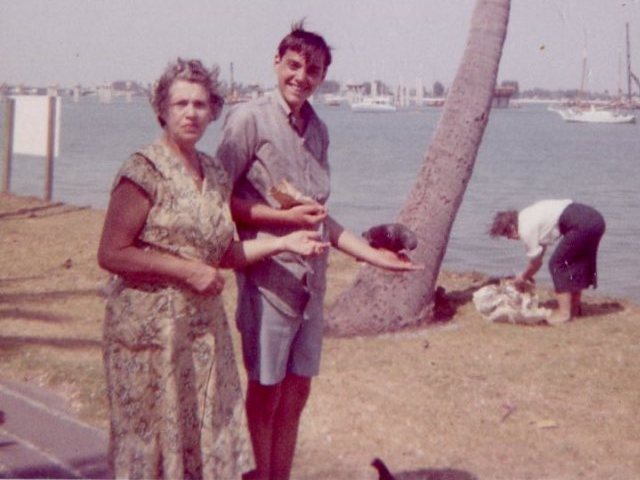
My family and I arrived in Miami from Cuba in October 1956 and that was the start of my lifelong love for all things American.

I have so many wonderful memories from that time, but a few stand out. The first Halloween and those sweet mallow pumpkins. Royal Castle hamburgers, eating roasted peanuts at Bayfront Park, visiting Crandon Park Zoo, and my sister and I taking turns sitting on my dad’s shoulders to see the Orange Bowl parade.

My parents tried to enroll me in first grade, but the school thought it best to have me begin in the fall of the following year since the term had already started and I didn’t speak English. It turned out they were right.

My mother used that year to have me practice reading and writing in Spanish and I learned English from my cousin, neighborhood kids and television. I Love Lucy, Sky King, Mighty Mouse, Captain Kangaroo and The Mickey Mouse Club were my favorites. By the time I started Riverside Elementary in the fall of 1957 I was completely fluent in English. We later moved near the Orange Bowl and I transferred to a brand new school, Citrus Grove Elementary.

In the summer, we would visit the playground at the stadium in the morning and watch amateur baseball games played there in the evening. We kids didn’t care about the game, only about the snow cones sold there.

At the corner of our block was a drugstore where we could get candy for a penny and a vanilla or cherry Coke for a nickel. You could buy a lot of sweets with just a quarter.

I remember all the kids in my neighborhood getting their hula hoops and my sister and I having to wait until the end of the week when my dad got his paycheck. That Friday evening we finally got our hoops, but when we returned home all the other kids put their hoops away and wouldn’t play with us.

My dad told us not to worry and play by ourselves, but that was boring. Then magically, as people leaving the stadium walked by, one man stopped and offered me a quarter to show him how I used my hoop. I put on a show and earned my quarter. All the other kids ran as fast as they could to get their hoops.

To this day, when reminiscing about the innocent fun we had as children, I remember my yellow hula hoop.

My sojourn to South Florida started before I moved here in 1957. My sister and brother-in-law were here from New York on a winter vacation on December 26, 1947. The metropolitan area of New York had a snowstorm of 26 inches in a 24-hour period. It was a record then and may still be to this day. My sister called my father to find out the conditions and my father told them to stay in Miami, the city was paralyzed, no transportation, nothing was going on. They decided to stay and move permanently to South Florida. They came back to gather their personal belongings.

I started coming down in 1950 when my nephew was born. I went to jai alai every night and sat in the balcony for 50 cents. Back then jai alai was the place to be, especially on a Saturday night. The highlight of my trip was when we would go to Leonard’s La Peña on Bird Road, where I think the Palmetto Expressway is today. The menu, if I am not mistaken, was a shrimp cocktail, steak or lobster, stuffed baked potato and, for dessert, hot apple pie with a slice of American cheese — all for $3.95 (plus tip).

I moved to Florida in 1957, a day after the New York Yankees lost to the Milwaukee Braves in the World Series. My parents followed me one month later. They bought a house one block north of the Tamiami Trail and Southwest 60th Avenue. There is an elementary school called Fairlawn, which also had a park with a baseball field. Playing there one day I was recruited by a team that was practicing. They mentioned a league they played in at Shenandoah Park off Southwest 22nd Avenue and 19th Street and asked me if I wanted to join their team. Naturally I said yes. It was a church league and I played for St. Matthew’s Lutheran one year and Shenandoah Baptist the following year.

My first job in Florida was at the Food Fair warehouse on Northwest 71st Street and 32nd Avenue. I believe at the time they were the largest supermarket chain in South Florida. Other supermarkets at the time were Margaret Ann and Kwik Chek, which eventually merged with Winn Dixie, their main competition. Other stores came and went such as Grand Union, Albertson’s, and Shell on Northwest 58th Street. Publix was not as prevalent around South Florida in those days, but of course they have come a long way since then.

In 1960 I bought a hardware store on Northwest 183rd Street and 7th Avenue. The Palmetto Expressway only extended from the Trail (Southwest 8th Street) to Golden Glades. They used to call the Palmetto “Dead Man’s Highway” since there were no overpasses, or very few. You had to drive way below the speed limit to avoid accidents since very few cars stopped or slowed down at the intersections. I think within a year they started building overpasses at key streets which opened the area to residences and businesses immediately.

Some familiar and favorite restaurants through the years were Gold Star Deli on the Trail, just east of 62nd Avenue, the Great Gables on Ponce and the Trail, The Pub (with Whitey the host) on Coral Way, Royal Castles all over, Shorty’s BBQ, Captain’s Tavern, and Frankie’s Pizza on Bird Road, which is still there under family ownership. Dressel’s Dairy Farm on Milam Dairy Road had rides for the children and the thickest malt shakes anywhere.

Miami Beach in the ‘50s and ‘60s was second only to Las Vegas in live entertainment — from Roberta Sherwood and Don Rickles at Murray Franklin’s to Charlie Callas and Shecky Greene at the Deauville Star Theatre and Buddy Hackett and Joan Rivers at the Diplomat. Movie theaters included the Miracle on Miracle Mile, the Tower on the Trail, the State and Claughton theaters.

I have been happily married to my wife Elaine for 52 years (45 for her and seven for me – our joke). We have three children (and one grandchild) and, 45 years on, still live in our house off Miller Road and Southwest 92nd Avenue.

I was an avid tennis player for 30 years and dazzled many courts such as the Dadeland Inn, Marlin Racquet Club, Kendalltown and Courts at the Falls until my shoulder and knees finally gave out.

In between all this I enjoyed a long and successful career in real estate, where our company built, developed and managed warehouses, retail strip centers and private residences, mostly between Bird Road and Southwest 120th Street, and also along South Dixie Highway and Kendall Drive out west, when it was largely undeveloped. It has been a great ride. Thanks for the memories, South Florida (Miami).

In 1951, I was young and it was the summer of my junior year in high school. I left St. Louis to join my older brother, a waiter at Martha Raye’s nightclub. It seemed to me to be an interesting life and he had agreed, after some pleading, to let me join him – as long as I worked and paid my own expenses. So, after apparently every possible stop in Kentucky, Tennessee, Georgia and Florida, my non-air conditioned Greyhound bus arrived in Miami Beach and I saw, for the first time in my life, the ocean, framed by palm trees, sand and the just rising sun — and I was hooked.

My brother lied about my age and my “several years” of experience to get me a union card and a job as a busboy. My “experience” consisted of an hour or so of practice carrying dishes and glasses piled upon an up-turned coffee table. From the late ‘40s through the ‘50s and ‘60s the Collins area between 20th and 25th Streets was one of the liveliest in Miami Beach. Martha’s Five O’Clock Club was on the corner of 20th and Collins; Collins and 22nd housed “Wolfies,” the quintessential New York delicatessen. The Grate, the Pin Up, the Place Pigalle and the Night Owls clubs were within blocks; the Embers restaurant and Dubrow’s cafeteria were nearby; Junior’s deli and the old Roney Plaza hotel were just off 23rd Street. The 22nd Street public beach, between the Roney and the Sea Gull hotel, was well known by natives for its homosexual clientele, both male and female, and occasional bewildered tourists, wondering just what they had stumbled on to. My daytime job was working for three dollars a day and tips as a “cabana boy” at the Sea Gull, handing out towels, setting up beach chairs and umbrellas, keeping an eye on guests in the pool and ocean and selling them on the local water ski schools, hand-woven palm hats, Monkey Jungle tours, scuba lessons and other “opportunities” for which, if they bought, I received a one percent commission.

In the 1950s, the Five O’Clock Club was a popular, small nightclub offering two shows a night and three on weekends. The club was named for dispensing free drinks to anyone still at the bar at 5:00 a.m. The 5:00 a.m. sessions were populated primarily by after-work waiters, waitresses and musicians from other clubs, an occasional hooker and sometimes, a celebrity or two. The club had a three-drink minimum and, if you didn’t order food at the 6 p.m. dinner show, you paid a separate cover charge. The experienced nightclub goer nursed a glass of wine, paid the minimum or cover and never, ever ordered food from what was one of the worst kitchens on the Beach. Martha’s was where I learned to maneuver trays of dirty dishware through narrow aisles of tiny, tourist-filled tables and sometimes helped the bartender water down the bourbon, scotch and rye. I also learned that the “snowbirds,” particularly those who had perhaps had a drink too many, were often easy marks for inflated bar tabs. Martha’s was a lesser club, not as big or flashy as Copa City, the Beachcomber or the Latin Quarter but, when Martha was on the bill, it catered to loyal locals and aging movie-going tourists who remembered her from her ‘30s and ‘40s Hollywood musical comedies and who appreciated her off-color comedy routines and very considerable talent as a jazz pianist and vocalist. The five o’clock shows also featured lesser comics, male or female vocalists on their way up, or down the showbiz ladder and, sometimes, a movie-star friend of Martha’s.

I sometimes frequented the Rockin’ MB lounge which featured saxophone duos, drums and no-name vocalists, performing from an elevated “stage” behind the narrow bar. The band played mostly tunes like Bill Haley’s “Rock Around the Clock,” always at full volume. The sound cast out on Collins from late night to early morning and the entrance sheltered a large, bored gatekeeper, seated on a stool, who casually checked IDs and denied entrance to nobody. The offices above the MB also housed a phone-filled “wire room” handling bookies’ action. This was still Meyer Lansky/Al Capone/pre-Kefauver Miami and the horse parlors, “private” casinos and bolito shops had not yet been shut down as consequence of the crusading senator’s traveling hearings on crime and corruption (Kefauver’s first hearing was in Miami in 1951). What wasn’t legally wagered at Hialeah or Gulfstream on the horses or at dog tracks on the greyhounds or at jai alai frontons was gambled with bookies in cabanas by the pool at the ocean front hotels — like the one at the Sea Gull.

The Rockin MB’s clientele, like that at the Sea Gull and other beachfront hotels, were mostly young tourists, often female, in groups of twos and threes — secretaries, teachers and office workers, down from East Chicago, Indiana, Cleveland or other cities up north lured to Miami Beach by the airlines and hotels advertising “3 days and 2 nights (or 7 days and 6 nights) of sun and fun” on the “American Plan” where airfare, hotel, and most meals were included in the package. For example, in the 1950s you could stay at the Di Lido or Shore Club and other ocean-front hotels for less than $27 a day and for an additional $25 get breakfast and dinner. The American Plan became very popular in the 1960s and its utilization by mega-hotels like the Fontainebleau and Eden Roc with in-house nightclubs and New York/Hollywood level shows and entertainers marked the beginning of the end for clubs like Martha’s as well as the bigger entertainment venues.

I met celebrities besides Martha — had my picture taken with Jake LaMotta and Rocky Graziano at the Sea Gull, parked a car for Elizabeth Taylor and Eddie Fisher, made sure Irving Berlin’s jock strap and bathing suit were dry for his morning dip, and was able to finance my “other” education at the University of Miami — thanks to Miami Beach and the generosity of tourists.

Growing up in Miami Springs during the 1940s was a sunny and happy experience if one was young enough to avoid the anxiety and trauma of World War II. I was one of the lucky ones because my dad was able to stay home and work at his job in telephone communications.

Each morning, he would drive downtown in his little gray Ford coupe, the blue gasoline sticker in the right window joined by the red one for Civil Defense. I was proud of his sense of responsibility working for Southern Bell Telephone. Most of us were still on party lines, but we felt good about reliable communication.

My classmates in second grade at Miami Springs Elementary were a mix of varied family situations. There were several dads overseas, but it wasn’t discussed by any of us at school. During this time, I happened to meet an outstanding grandfather of one of my classmates. Anne was my best friend .

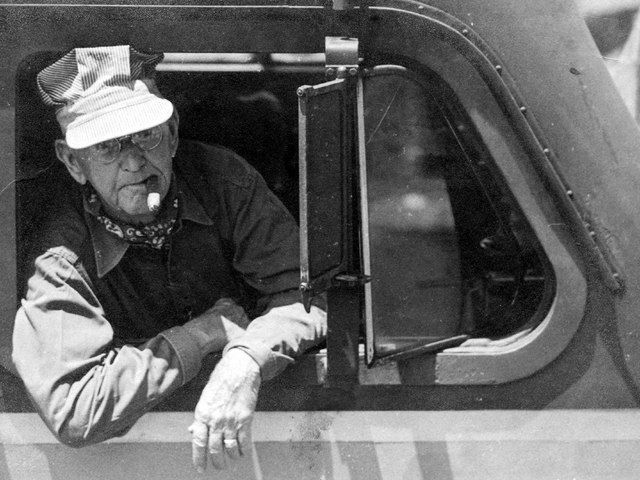
The highlight of our friendship was the opportunity to meet her grandfather, an early engineer with the Florida East Coast Railway. It was a short walk to her house and, as we left school one September afternoon, she saw his bluish-gray car parked out front under the big pine tree and said, “You have to come inside and meet Choo-cha-bah!”

Taken aback by the name, I asked her tentatively, “Who’s Choo-cha-bah?”

She replied, “He’s my grandpa, and he’s real nice!” So I followed her into the house and there was a giant man, sitting in a big chair, talking with Anne’s mother and younger brother, Sonny.

Her mother met me with a big smile and introduced me to the visitor. “This is Anne’s grandfather, Choo-cha-bah. He works for the railroad!”

He then stood up, gave Anne a big hug and offered his hand to me. He had a kind manner and I felt comfortable. I didn’t stay long; I talked a few minutes about school, and then left for home. It was wonderful for me to have a new friend who looked like he could be anyone’s grandfather. Tall, strong, and gentle he was, and I was to learn he had made a valuable contribution to Henry Flagler’s progress in bringing the railroad down to Miami.

“Choo-cha-bah” will be referred to by his name, Fred A. Daniel, as I relate the rest of my story.

He grew up in the Palatka-Orange Lake area as a boy, where his father was a cattle driver and worked irregular schedules to bring in a salary. His mother worked as a milliner, which meant she would fashion hats out of available material and make a little money when she could. Historically, I’m placing them in the late 1870s. I’m not sure how many children were in the family.

Not much was going on in North Florida, other than what an individual could conjure up for himself. Cattle roamed freely, grazing where available, and offered an opportunity for individuals with a horse and good strong rope to bring home a starting source of beef. Smaller wildlife was available; quails and wild geese roamed freely, but you needed to be able to capture them and secure them. Small farm patches with greens, corn, and maybe a fruit tree could supplement the food needs.

Let’s get back to Fred.

He went to school for three years and then started looking around for more opportunities to help out. He got close enough to the Jacksonville-St. Augustine area to see that Henry Flagler had arrived and was making plans to use the Florida climate and his wealth to establish a new home base for his sick wife and his work interests. He had become a millionaire working with John D. Rockefeller and Standard Oil in Ohio. Arriving in the beautiful sunshine of North Florida in the late 1800s, he and his wife both fell in love with the area.

Mr. Flagler worked to connect the railroad from Jacksonville down to St. Augustine. With that accomplished, he built the beautiful Ponce de Leon Hotel as their new residence. As you know, in business one thing leads to another, and he saw opportunities to spread the business in several directions. In 1888, he added the St. Augustine and Palatka Railroad to the St. John and Halifax railroads. At this point, he had a unified rail system down as far as Daytona Beach.

Do I need to remind you who was walking around this part of the state looking for miscellaneous work opportunities? Yes, Fred found the opportunity to work, carrying water for Flagler’s workers. That’s what he told us of his first job. Not very difficult, but very necessary to fire up the engines and satiate the thirst of the laborers.

Fred learned a lot by just being on the scene. Without qualifications, he was carrying whatever was needed from supply location to work station. No doubt, he learned quickly, for he advanced and continued to work for Flagler and the Florida East Coast Railway, even through the time the FEC lost its battle with “Hurricane 1935” in the Florida Keys.

Because of my older sister Gilda’s illness, my parents, Hedwig and Benjamin Goldstein, were advised in 1942 to move from the Bronx to Miami Beach, where we lived at the La Flora Hotel on Collins Avenue.

Every hotel was filled with Army recruits, who marched on Collins Avenue holding their faux rifles, which were actually broom sticks. As a 5-year-old, I used to dress up in my Cub Scout uniform and watch the soldiers, saluting them as they approached.

Shortly thereafter, my sister and I went to the Normandy Boarding School in Normandy Isle, where I lived and was in kindergarten. .

My parents then bought a house on Alton Road and 43rd Street, where my mom lived for 68 years. On Sundays, I would take my wheelbarrow with coconuts and coconut milk and sell them to the people visiting soldier-patients at the Nautilus Hotel, a military hospital that later became Mt. Sinai Hospital.

I was 6 years old at the time, and it was 1944. I was enrolled at North Beach Elementary, followed by Nautilus School when it opened in 1950, and Miami Beach High School, which I attended through graduation in 1956.

Between ages 11 and 14, my friends and I rode our bicycles everywhere. When I rode my bike for my newspaper delivery route, there was so little traffic I could literally traverse from one side of the street to the other with little effort.

My friends also rode their bikes to school, as well as to Temple Beth Sholom, where my parents were founding members and I was bar mitzvahed and confirmed.

Most of my friends and I earned our recreational money ourselves doing an assortment of odd jobs: delivering newspapers, bagging food at Carl’s, Food Fair and other local markets, and cleaning cabanas or the pool area at various beachfront hotels.

Where the Fontainebleau stands today was the old deserted Firestone estate. We often would catch sand crabs on the beach for bait and walk onto the jetty to fish. As we got older, we rode our bikes with our girlfriends on the handlebars back to that same spot behind the estate, and on a moonlit night it was very romantic.

Weekend mornings offered the opportunity to catch local crawfish as we walked along the sea wall behind houses along the various Beach canals. Today, we’d probably get shot or arrested for trespassing. But back then it was OK, and the residents of the homes who saw us always smiled and wished us luck. We would sell the crawfish to our parents’ friends for 50 cents.

While playing basketball for Beach High, and as captain my senior year, I made life-long friends with both Coach Milt Feinstein and Chuck Fieldson. About six years ago, along with teammates Dr. Richard Berger, Lou Hayes, and Donald Klein, I was fortunate enough to be invited to Coach Feinstein’s surprise 90th birthday party.

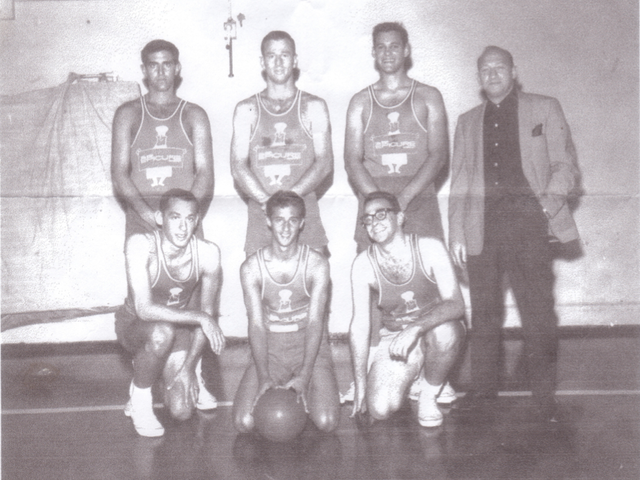
After college graduation, I played basketball on the championship Epicure Market basketball team, which even played at the Miami Beach Auditorium against the University of Miami freshmen, including the great All-American Rick Barry.

After graduation from high school, 10 Beach High graduates, including myself, enlisted in a special new Army program with six months active duty followed by seven years Army reserve.

I will never forget the train ride from Miami to Columbia, S.C. (Fort Jackson). It took almost 24 hours and stopped at every town along its path to pick up more recruits. This was 1956, significantly before integration.

Ironically, the boys from Miami Beach were all Jewish, and when we arrived at the barracks, the bulk of the recruits from North Florida, Georgia and South Carolina were unfamiliar with both African Americans and Jews. Our Miami Beach group assimilated easily and quickly with the African-American recruits. Our barrack consisted roughly of 10 boys from Beach High, five or six whites from West Palm Beach, and approximately 15 African Americans from Florida. We got along famously!

It was one of the most interesting and maturing experiences in my entire life and a great transition from high school to college. I returned from my Army service a different person.

Upon graduation from the University of Florida I went to work as a C.P.A. for my father. Our firm today has grown from Benjamin Goldstein, C.P.A. to Goldstein Schechter Koch, C.P.A.s, which employs 115 with offices in downtown Coral Gables and Hollywood. We still have many clients who have been with the firm for more than 65 years, covering three generations. We also have many clients who were my high school friends. Until 2007, three generations of Goldsteins worked at the firm: my mother, my daughter Laurie Adler, and me.

My mother retired at the age of 95, after driving herself four days a week from her home on Alton Road to our offices on Ponce de Leon Boulevard.

The reality is that I have never really left Miami Beach. Neither have most of my friends. Being a Beach guy is a unique distinction of which I will always be proud.

I was born and raised in Brazil.

I was 17 years old when I began my banking career there. In 1986, I was offered a job at a Brazilian bank to manage its Miami branch. I lived here for four years before leaving to work in London and Grand Cayman.

I returned to Miami at the end of 1997 and purchased an apartment in Key Biscayne, where I lived for two years. At the beginning of 1998, I was hired as financial director of a Brazilian company on Brickell Avenue.

In 2000, I was offered a job at an American bank to open a branch here in Miami.

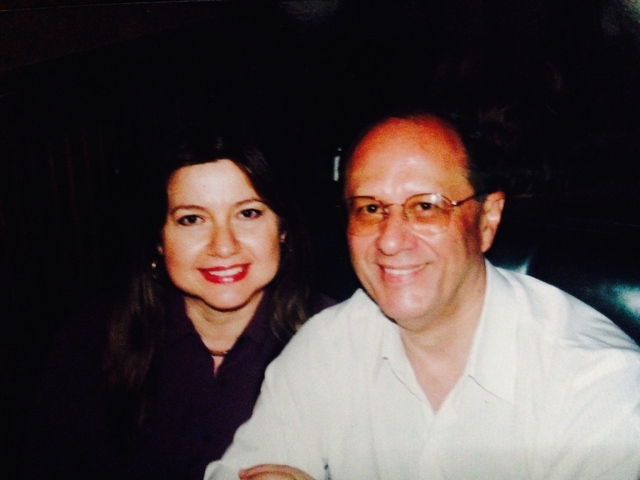
In the meantime, I met Carmen Crespo, Cuban-born and educated in Chile. Carmen was a singer by night, financial consultant by day. Upon first meeting her, I was inebriated by her voice.

After dating for four years, we became engaged, and were married in 2008. Carmen is a big supporter. I am sure that her encouragement empowers me to continue to forge ahead, beyond any obstacles that we may face in our lives together.

For many reasons, I realized that I had to move from Key Biscayne. I sold the apartment and bought a new one in Doral. When I married Carmen, we bought a beautiful house in the city of Sunrise. We’ve been here ever since.

I worked at the American bank until 2010, when I left the banking industry to devote myself to writing.

In Miami, I participate in some cultural organizations and associations that allow me to expand my thoughts by writing essays on different subjects. I have written two books, with versions in Portuguese and Spanish.

My experience in Miami has shown me that here we have the opportunity to make relationships with many kinds of people. For example, at a meeting you can sit at a table with someone who is from Colombia, another from Venezuela, another from Chile, another from Asia, another from Europe. We have to maintain a diversified dialogue with people of different cultures who do things differently. This gives us ample possibility to be flexible with others and, at the same time, with ourselves.

And we have to accept or accommodate ourselves to those styles of life to be happy within the environment where we choose to live. We learn so much from this experience.

In my opinion, it’s not the people who should accommodate us. Instead, we should accommodate them. In terms of culture itself, I believe that in Miami we have the opportunity to come face to face with these situations.

In addition, if we explore, we can find many cultural events here. It’s a question of looking for what is most convenient for us. If we go to Miami Beach, for example, we can find a lot of events occurring on a daily basis.

We cannot talk about this city if we do not mention the beaches. We have to know how to use the beaches and to take advantage of them. It’s in the best interest of our health, too, because we know that the water from the sea has a lot of energy.

Simultaneously, we are among other people who want to share their time and experience with us, and it results in a beneficial situation for everyone. The same can be said for tourism. If we do not consider the tourism part of this community, we will be divorced from a visible reality.

We can note this when we are walking in downtown Miami or even in Miami Beach. We will see a lot of people with different clothes, different hats, different smiles. But everybody who appears in Miami comes with a purpose. They come here to be happy and to enjoy the sunlight that nature offers.

As residents, we should take advantage of all that Miami has to offer. We should enjoy it as the tourists do. We should be flexible — go to the beach, go to the museums, and know the cultures of other countries. We should also be on the lookout for the variety of events that the city offers. This is the integration that exists between ourselves and this cosmopolitan city that opened its arms to receive us.

This is Miami, a city to which I am deeply linked.

Every night after dinner, the four of us would gather around the cramped dining table in our apartment on Kendall Drive, quizzing one another, working on our English pronunciation, memorizing medical concepts, multiplication tables, SAT vocabulary — whatever had to be memorized — drying every stubborn tear because there was not a second to waste.

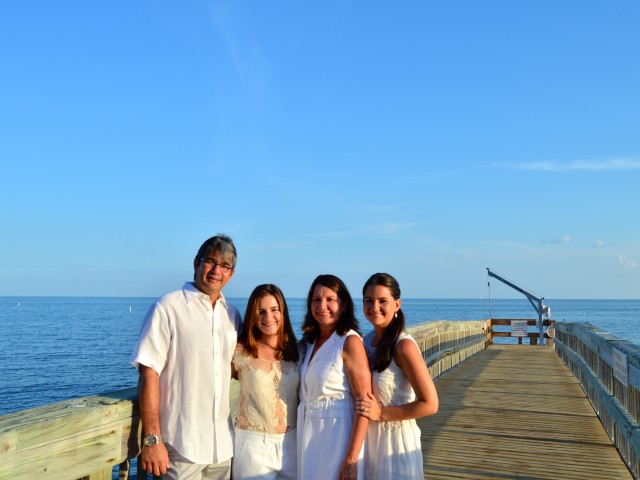
We were like a startup. When my parents decided to leave Cuba and moved us to Miami in 2002, they were determined to build our own future from scratch. My father, Héctor Chicuén, an electrical engineer, would find work at Florida Power & Light. My mother, María Victoria García, a pediatrician, would certify her medical degree. My younger sister María Cristina Chicuén and I would attend college. This was our business plan. What we lacked in resources, we made up for in drive, an unspoken no-excuse philosophy, an overabundance of togetherness.

Within our family enterprise, teamwork was essential. Whether at a Home Depot, a local Christmas tree shop or a cement factory, my dad would pack his weeks with two and sometimes three jobs in order to make ends meet so that my mom could devote her time to the medical certifications. Some days, when the orange juice disappeared from our kitchen as we ran out of money, when stress drove my dad to twitch his eyes like a flickering emergency light, my mom would close the textbooks.

“No es fácil,” she’d say as she grabbed a mop and drove the short distance to Pinecrest, where good cleaning services were always welcome at the ranch-style estates carved deep in the lush, tropical landscape. Or we’d head to a local gym together. My mother took care of toddlers while their parents exercised, and I prepared protein shakes at the gym’s cafeteria.

These were my high school years, which now blur in my mind, forming a mosaic of sleep deprivation, five-minute phone calls to relatives in Cuba and endless homework for as many advanced courses as I could fit in my schedule. On a rare occasion, as a reward for good grades or a promotion, as a little pause in all the hustle, we would treat ourselves to a family meal at Denny’s.

“Hi, hello, I would like a coffee with milk,” my mom would request in her rehearsed English version of “Hola, qué tal, un café con leche por favor.” The waiter, of course, would proceed to bring a glass of American coffee and a glass of milk.

We also used to rent movies from Blockbuster. We had given up on movie theaters since our first experience, on the release of the original Harry Potter movie. Dressed in our best clothes for what we thought was a special night out, we were baffled by the teenagers in shorts and tank tops — “hasta en chancletas” — flooding Kendall Regal Cinema.

Time had never been so precious to us. Every hour of my father’s work meant $6, $8, $9, $14, $18 to sustain the entire family. One more hour of study brought my mother closer to certifying her medical degree. One more hour at school meant my sister and I were more fluent in English, more prepared for a complex education system we were determined to conquer. That’s why we would arrive at family gatherings with a textbook under our arms, or pass on parties altogether if there was an opportunity for overtime work or a tutoring session.

We took advantage of every resource and free lunch. Even free dinners. On the morning of our first Thanksgiving, the staff from my sister’s elementary school gifted us with a sumptuous turkey we had no idea how to cook. “We’ll roast it like pork,” we thought, as we did in Cuba for every major celebration. Soaked in our traditional marinade of garlic and bitter orange, accompanied by yuca, fried plantains, steamed white rice and black beans, our own bicultural turkey was soul-nourishing. And we were deeply thankful.

Steady, we kept studying and working as hard as we could. It was well into our third year in Miami when the unmistakable light of good fortune crept through our windows. My father received the dream offer from Florida Power & Light. My mother passed her medical board exams and was accepted to a residency program at a prestigious hospital in New York. I received a letter of admission and a generous scholarship to attend Harvard University.

Miami refused to let us go. As we readied to embark on a new adventure in the Northeast, just a few weeks before my high school graduation, my mother was diagnosed with breast cancer.

We would not give up. We had won the most difficult battles — separation from our family, poverty and unemployment, loneliness, the inability to express our most basic needs and feelings. We would not give in to illness.

For months, my mother fought through chemotherapy, radiotherapy and hours of surgery until she recovered and claimed the spot she had earned so rightfully at her medical residency. Today, she is a primary-care physician in Little Havana, an area of critical medical need.

My father’s career at Florida Power & Light spans over 10 years. As he has risen through different roles and departments, he has been able to coach other recent immigrants on successful applications for employment at the company.

My sister is now in her third year of college at Stanford University. Every summer, she returns to Miami, where she has interned with the Miami Heat and farmers markets to complement her studies in health policy and urban food systems. She is preparing herself to promote wellness in our city after she graduates.

I am at Miami Dade College. From my post in the college president’s office, I recognize in the faces of many of our students the same determination and thirst for opportunity that first brought my family to Miami, and which continue to drive every one of our individual and collective endeavors.

This city has given us a brighter present than we could have ever imagined.

It’s our turn to pay it forward.

Maria Carla Chicuén is the author of ‘Achieve the College Dream: You Don’t Need to Be Rich to Attend a Top School.’

I remember looking out the window as the plane took off from Havana.

It was Aug. 9, 1960. I was 15 years old and leaving my country with my mother and brother to reunite with my father in Miami. He had left months earlier to find schools and a place to live. We didn’t realize it would be for good.

My dad, an attorney with a passion for travel, got a job in sales with Guest Airways and an apartment at 23 Phoenetia Ave., Coral Gables. He enrolled my brother and me at Merrick Elementary and Coral Gables Senior High, respectively.

Two other families we knew from Havana lived in the same eight-unit building, and we would gather in the small patio in the early evenings. But Miami was a very quiet town in those days and we were asked to move.

We did, a few blocks away, to Madeira 25A, an apartment building that has also gone condo, and gone are the wooden stairs with the telling creak that would let me know Abuela was coming down the stairs. Gone, too, are the Coliseum, a great place to bowl, hang out and listen to Top 40 in the jukebox, and the old Coral Gables library, which I remember every time I smell the rain.

My dad opened a travel agency, Caribbean Cruises, on Ponce de Leon Boulevard next to the Coral Theatre. Neither has been there for years. My mom went to work at the Shelborne Hotel in Miami Beach as an executive secretary to the general manager, which meant she ran the place. That is where I had my honeymoon a couple of years later and where, a couple of years ago, I went for karaoke.

My parents made those lean early exile years a warm and fun experience. We had an old car that my dad named “Can you give me a little push,” and we took car trips to Matheson Hammock and Crandon Park. We sang along with musician Mitch Miller and played Clue and Monopoly and we were active on the Cuba issue and even slept in Bayfront Park once to protest something WCKT news anchor Wayne Farris had said.

My boyfriend and many friends were in the Brigade 2506 that invaded Cuba in 1961. He went to prison and the experience changed his life and the lives of Cubans everywhere. But my parents helped make the memories of those times mostly good ones and, at 16, wounds heal fast.

In Miami, I discovered tuna fish sandwiches on plain white bread and French fries with ketchup. I also discovered prejudice. Looking for places to rent, we saw signs that read: “No blacks. No dogs. No Cubans.” The counters at Woolworth and Grant’s were segregated, so were water fountains and buses.

The good old times were not good for everyone and it almost seems impossible that those memories could co-exist with so many wonderful ones: driving up to Jimmy’s Hurricane on U.S. 1 and Bird Road, where servers on roller skates would come to the cars, just like in the movies; parties at the Venetian Pool, Friday nights at the Pizza Palace, window shopping on Miracle Mile and snacking at Jahn’s Ice Cream Parlor (where John Martin’s Irish Pub now stands). Sundays, after mass, the go-to spot was Walgreens downtown.

There were Friday night dances at the Coral Gables Youth Center and sock hops at the school gym, where rock ‘n roll was danced the way many have only seen on TV. There was the thrill of a pep rally and the way the air smelled around football season – I don’t know about your high school, but we were the Cavaliers, and that meant something!

There was a Howard Johnson’s inside the old Coral Gables bus station and we would stop on our way home from school for their famous “caramel” ice cream ( Dulce de Leche did not come into its own until 40 years later).

My younger brother was born at the old St. Francis Hospital in Miami Beach in 1961 and one year later, I graduated from Gables High, went to Dade County Junior College and had my first part-time job at Jackson Byron’s in downtown Miami. My first real job was as clerk typist at the Welfare Department; my husband worked three blocks away at what used to be Mary Jane Shoes on Flagler. We had met at the Vedado Tennis Club in Havana as teenagers, reunited here and got married at the Church of the Little Flower in Coral Gables in 1963. Our three children and four of our grandchildren have been born and raised in Miami.

When I first came to what is now my city, there was hardly anything open after 7 p.m. The Freedom Tower was the tallest building and Dadeland Mall was considered the “boondocks.” Our now ubiquitous Cuban coffee could only be had at home – Jose Enrique Souto, Sr., a family friend and the owner of Bustelo and Café Pilon, would deliver bags to our home from his truck.

My husband developed his professional career in computer systems at Eastern Airlines and, after its demise, became an executive at System One and EDS. When writing got the best of me, I began working at Harper’s Bazaar in Spanish, followed by a stint publishing Eventos Miami, a local social/cultural magazine. Miami in the ‘80s was ripe for that decadent scene: Ensign Bitters, Cats, The Mutiny, The Jockey Club and Regine’s in the Grand Bay, where Julio Iglesias visited often and the Dom Perignon flowed easily.

I’m presently retired from advertising, and we just celebrated our 50th wedding anniversary, right here in Kendall. Most of our family lives here and has grown with Miami. Is it perfect? No. But it is ours. And it is home. So when someone tells me we have the rudest drivers and we’re a banana republic and yada, yada, yada, I say “just move, chico.”

Translate »